


OMIM ID:
Duane-Radial Ray Syndrome
Alternate Names
Defective Genes
Clinical Characteristics
Ocular Features
Most individuals have features of Duane’s anomaly, sometimes unilaterally. Optic pallor with poor vision has been described in well-studied patients who also had thinning of the retinal nerve fiber layer. The optic disk may appear hypoplastic. Visual evoked potentials and pattern ERG amplitudes are decreased.
Other less common ocular features are microcornea, microphthalmia, ophthalmoplegia, hypertelorism, cataracts, epicanthal folds, colobomas, and chorioretinal scars.
Systemic Features
The systemic features are inconsistent (variable expressivity) with most patients having some variation of hypodactyly, polydactyly, syndactyly, and malformation of the hands. The thumb is the most common digit involved and this is often associated with thenar hypoplasia. Other skeletal features of the radial ray syndrome including absence of the radial and ulnar bones are variably present. Hearing loss is described as sensorineural in etiology but malformations of the pinnae and external meatus are sometimes present.
Kidney anomalies include horseshoe malformations, abnormal rotation, ectopia, small size, vesicoureteric reflux, and pelvicalyceal dilatation.
Genetics
Inheritance
This is an autosomal dominant disorder due to heterozygous mutations in the SALL4 gene (20q13.2).
This syndrome is sometimes confused with the Holt-Oram syndrome but the latter is the result of mutations in a different gene and lacks ocular and renal abnormalities. Duane syndrome 1 and 2 may also occur as isolated conditions.
The considerable clinical heterogeneity has led to alternate titles for this syndrome. For example, what is sometimes called the IVIC syndrome (147750) with similar features is also caused by mutations in this gene. Duane-radial ray syndrome has also been called Okihiro syndrome.
Pedigree
Autosomal dominant
Autosomal dominant disorders require only one mutation for the disease to be expressed. Since an affected parent has two chromosomes, only one of which has the mutant gene, parents can expect that half (50%) of their children will receive that one and inherit the disease. It is common for individuals that inherit the mutation, however, to not have evidence of the disease (nonpenetrance).
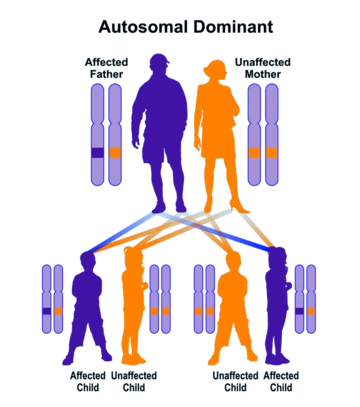
Autosomal dominant inheritance leads to a vertical pattern of transmission